
The 2005 penny value is usually low. That is the first thing collectors notice. The date is modern, the mintage is huge, and most examples are easy to replace. A coin checker app will often show that right away.
But the year is still worth a closer look. The 2005 cent includes regular circulation strikes, proof coins, and satin finish issues from Mint Sets. Once those versions are separated, the market starts to look less simple.
The 2005 Cent in Context
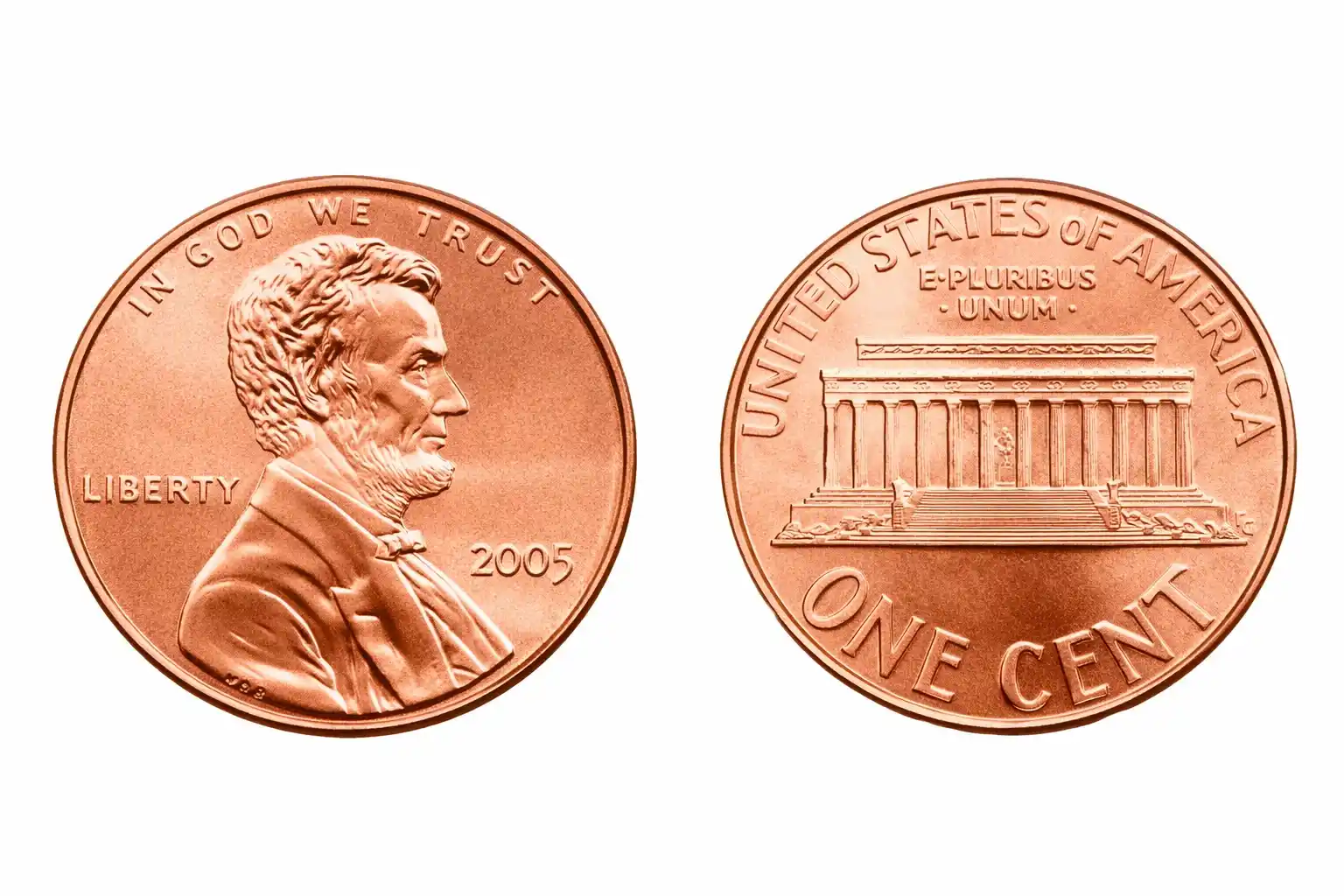
The 2005 cent belongs to the Lincoln Memorial series. It is a copper-plated zinc coin, not a bronze issue. It was made in very large numbers for circulation, and that keeps the lower market quiet. Philadelphia struck more than 3.93 billion pieces. Denver struck more than 3.76 billion. San Francisco produced more than 3.34 million proofs. These are large totals. They explain why circulated coins and average raw uncirculated pieces stay inexpensive.
The year still matters to collectors. It was the first year of the satin finish Uncirculated Coin Set format. That changed the collector side of the market. It also created a useful contrast: ordinary circulation strikes often came weak, while the Mint Set satin finish coins came much nicer. That contrast is the real story of the 2005 cent.
2005 Cents Issued Variants
Before discussing value, the issues must be separated. This date is not one coin. It is a small group of related coins with different formats and different markets.
| Type | Mint mark | Format | Main collector role |
| 2005 | none | business strike | circulation coin |
| 2005-D | D | business strike | circulation coin |
| 2005-S | S | proof | collector issue |
| 2005 Satin Finish | none | special strike from the Mint Set | collector set coin |
| 2005-D Satin Finish | D | special strike from the Mint Set | collector set coin |
This split is basic, but it matters. A circulation strike and a satin finish coin should not be treated as the same product. A proof should not be compared to a bank find in the same way. Each version has a different purpose, a different look, and a different price structure.
Design, Composition, and Core Specifications
The 2005 cent still uses the Lincoln Memorial reverse. Victor David Brenner designed the obverse. Frank Gasparro designed the reverse. The coin follows the standard modern cent specifications.
| Parameter | 2005 cent |
| Composition | copper-plated zinc |
| Weight | 2.50 grams |
| Diameter | 19.00 millimeters |
| Edge | plain |
| Obverse designer | Victor David Brenner |
| Reverse designer | Frank Gasparro |
These numbers are routine, but useful. They help with basic identification. They also matter when a collector checks a possible off-metal claim, an altered coin, or a cent that does not look right for the year.
Why the Coin Looks Common
At first glance, the date looks ordinary. That is a fair starting point. The regular 2005 and 2005-D cents were struck in the billions. They are modern. They have no silver content. They survive in large numbers. USA Coin Book places both regular business strikes at about $0.36 or more in Mint State, which shows how flat the lower end of the market still is.
That low-end view is not the whole market. It only describes the bottom layers. Once the coin moves into better preservation, the market stops treating every 2005 cent as interchangeable. That is where the year becomes more selective than its mintage suggests.
High Supply, High Survival, and Weak Regular Strikes
The 2005 date has another feature that changes the story. The coins are common, but the regular circulation strikes were not especially well made. The 2005 Philadelphia issue and 2005-D circulation strikes were made with poor quality, and that even MS65 or MS66 examples were difficult to find in circulation. That is an important point. A date can be common and still become selective when quality rises.
This creates a useful split for collectors:
- Low-grade and average pieces stay cheap
- Ordinary raw Mint State pieces remain modest
- Genuinely clean higher-grade coins become more interesting
- Top certified pieces move into a much thinner market
That is why the year should not be dismissed too quickly. The supply is massive. The quality is not equally strong across that supply.
Color and Surface Quality
Color still matters on a modern cent. For business strikes and satin finish cents, collectors use the standard Brown, Red-Brown, and Red designations. PCGS lists separate categories for these color levels on the 2005 issues, which shows that the market does not treat them as minor details. Red coins remain the preferred look at the top end.
Surface quality matters just as much. A 2005 cent can be Mint State and still look average. Weak strike, dull color, uneven plating, and field marks drag the coin down fast. On a better coin, the color is stronger, the surfaces look cleaner, and the overall eye appeal holds together.
A practical check for a regular 2005 cent is simple:
- Look at the color first
- Inspect the fields for abrasions
- Check the strike on the Memorial details
- Compare brightness and texture with a known nicer coin
- Treat Red coins more carefully, because that color premium can widen fast in top grades
For this date, quality is a better separator than the year itself.
Satin Finish: The Collector Format That Changes the Year
The satin finish coins are the most important extra layer in the 2005 story. The U.S. Mint introduced the new finish for the 2005 Uncirculated Coin Set. The official release announced that the 22-coin set would, for the first time, have a satin finish and would sell for $16.95. The Mint also stated that the new finish would help collectors distinguish Uncirculated Set coins from regular bag and roll coins.
PCGS explains how these coins were made. The dies were sandblasted, the blanks were burnished, and the result was a special satin-like appearance. Satin finish coins were struck from 2005 through 2012. Most 2005 satin finish cents came in really good quality, with many grading around MS67 to MS68. Better pieces reached MS69, while MS70 stayed very rare.
The contrast with the regular strikes is sharp.
| Feature | Regular 2005 cent | 2005 Satin Finish cent |
| Main purpose | circulation | Mint Set collector issue |
| Typical quality | often weaker | generally stronger |
| Strike look | ordinary business strike | special satin-like appearance |
| Market focus | grade and eye appeal | set status and upper grades |
This is the section that turns the year from ordinary to interesting. Without a satin finish, 2005 would mostly be a common-date modern cent story. With a satin finish, the year gains a second collector market.
Proof Coin and the Meaning of Cameo and Deep Cameo
The 2005-S proof belongs in a separate category. It was struck for collectors. It was not made for circulation. The mintage was 3,344,679, which is lower than the business strikes but still large enough to keep most proof examples affordable. According to the USA Coin Book, the proof is about $4.96 or more, which reflects a normal collector issue rather than a scarce coin.
For proofs, contrast matters. Cameo means there is a visible contrast between mirrored fields and frosted design elements. Deep Cameo means that contrast is stronger and more complete. On the 2005-S cent, Deep Cameo is the look collectors usually want. It does not turn the coin into a rarity, but it defines the preferred proof appearance.
The main point is simple. Proof value comes from finish, preservation, and proof quality. It does not come from circulation scarcity. That is why the proof should never be mixed into the same value discussion as a regular 2005 bank coin.
Value Structure by Type and Grade
The value spread becomes clearer when the formats are separated. The lower market is quiet. The upper market is selective. This is where the year stops looking flat.
| Type | Lower range | Typical collector level | Higher-end certified market |
| 2005 regular strike | face value to very low premium | about $0.36 to $1.50 in raw Mint State | roughly $7 to $1,582 in certified higher-grade sales |
| 2005-D regular strike | face value to very low premium | about $0.36 to $1.50 in raw Mint State | roughly $6 to $1,125 in certified higher-grade sales |
| 2005-S Proof | about $2.25 to $3.25 for typical raw proof pieces | about $4.96 and up; PR69 DCAM pieces often around $11 | roughly $11 to $66 and up for stronger certified examples |
| 2005 Satin Finish | collector premium above regular circulation strikes | often about $19 to $37 in the SP67 to SP68 range | roughly $7 to $2,925 in certified sales |
| 2005-D Satin Finish | collector premium above regular circulation strikes | often about $10 to $30 in the SP67 to SP68 range | roughly $6 to $98 in certified sales |
Prices may change; check actual data.
The table needs one short explanation. The regular strikes stay cheap until true grade quality appears. The proof remains stable unless the quality is exceptional. Satin finish coins are better made, but most are also well preserved, which keeps the middle of that market modest. The real money starts only at the very top.
How to know the coin’s price effortlessly? For a quick first pass, a coin appraisal app free can help organize the search. Coin ID Scanner is useful there because it can identify a coin from a photo, show a basic coin card, keep several examples in one collection, and give a quick starting reference for type and value.
Are Errors and Varieties the Main Story
No. That is not the main story of 2005.
The major price guides and standard references do not point to one famous, must-know 2005 error that defines the year. The main market story is still regular strikes versus satin finish, not one legendary doubled die. That said, varieties do exist. Variety Vista lists multiple doubled die reverses for 2005 Philadelphia cents, including DDR-001 and several others. These are real specialist listings, but they are not the center of the mainstream 2005 market.
That distinction matters. A specialist can hunt those listings. A general collector does not need them to understand the year. For most buyers, the smarter question is still this: regular strike, proof, or satin finish, and how good is the coin in that category?
Who Should Collect the 2005 Cent
The year suits several kinds of collectors.
- Lincoln Memorial date-and-mint set collectors
- Proof set collectors
- Mint Set and satin finish collectors
- Modern cent buyers who focus on top grades
The date is useful because it offers more than one path. A beginner can buy the regular P and D coins very cheaply. A proof collector can add the 2005-S without much cost. A more advanced collector can chase high-grade Red circulation strikes or strong satin finish examples. The year is not dramatic. It is practical. That often makes it more useful than a louder date.
Conclusion
The 2005 cent is usually a common modern issue. That part is true. The full story is different. The year becomes more selective when the coin is clean, well struck, strongly Red, or tied to the satin finish format. The proof belongs in its own lane. The regular strikes belong in another. Errors and varieties sit further to the side.
That is why the date still deserves attention. It is not valuable because it is old. It is not valuable because of one famous mistake. It becomes interesting when quality rises above the large surviving base.